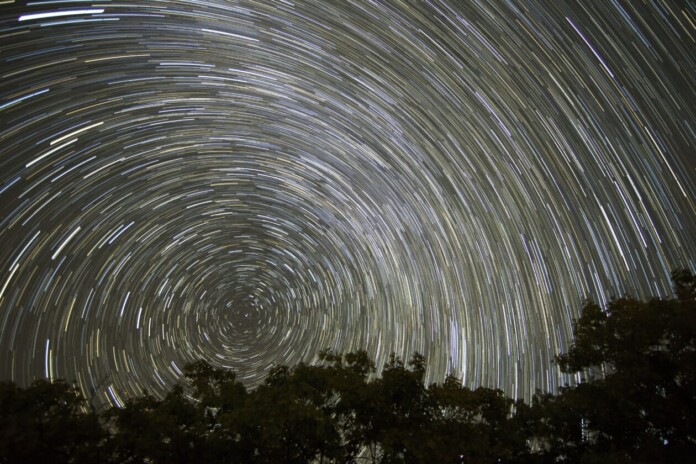
Capturing star trails is one of the most rewarding experiences in night photography. Unlike simple shots of the Milky Way, which freeze the sky in a single moment, star trail images illustrate the passage of time by showing the stars’ apparent movement as Earth rotates. The result is a magical swirl or streak of light across the heavens, turning an ordinary night scene into something both scientific and artistic.
While the concept is straightforward, the execution takes planning, patience, and an understanding of your camera. In this guide, we’ll walk through the two most common methods for photographing star trails — one using multiple shorter exposures and another using a single long exposure. Both approaches produce stunning results, and your choice will depend on your equipment, location, and creative vision.
Preparing for a star trail session
Before pressing the shutter, it’s important to set yourself up for success. Star trails can take hours to capture, and small mistakes at the start often mean wasted time later.
- Find the right location
Light pollution is the enemy of astrophotography. To get crisp trails, you’ll need to travel to a dark site away from city lights. Check light pollution maps online, and try to plan your session around a new moon for maximum visibility. - Check the sky conditions
Even a few thin clouds can obscure the trails. Look for clear skies and low humidity. If you can, schedule your shoot during the winter months, when the air is generally cooler and drier, providing better clarity. - Plan your composition
A photo of the sky alone can be beautiful, but the best star trail images usually include an interesting foreground — like a mountain ridge, a desert tree, or an old building. This grounding element provides scale and context for the sweeping arcs above. - Lock down your camera setup
Use a solid tripod that won’t shift during hours of shooting. Turn off lens stabilization, since it can actually introduce blur when the camera is still. Switch to manual focus, aiming at a bright star or distant light to ensure sharpness. Don’t forget to disable in-camera long exposure noise reduction, which can double your shooting time. - Dial in your white balance
Instead of leaving white balance on auto, set it manually — something around 4000 K usually balances the cool tones of the sky with any warmer tones from your landscape or nearby light sources.
Once all of this is in place, you’re ready to choose your shooting method.
Method 1: multiple short exposures (stacking)
This method involves taking many short exposures — usually between 20 and 60 seconds each — over the course of one to two hours. Later, you merge all of these frames into a single image where the stars appear as long, continuous trails.
How it works:
- Camera settings: Set your camera to manual mode. A good starting point is f/2.8 (or the widest your lens allows), ISO 800, and a 30-second exposure. Adjust these depending on your lens and the brightness of the night sky.
- Use an intervalometer: This device (or an in-camera interval shooting mode) automatically triggers the shutter for you at set intervals. Set it to take one shot after another with only a one- or two-second gap between frames.
- Keep shooting: Depending on how long you want your trails to be, you may need hundreds of frames. For example, shooting continuously for an hour at 30 seconds per exposure would yield 120 images to stack.
- Post-processing: After the shoot, import your photos into specialized software like StarStaX, ImageStacker, or even Photoshop. These programs combine your images, aligning the stars and filling in gaps to create smooth, flowing trails.
Advantages:
- Less sensor heat, meaning lower digital noise.
- If one frame is ruined (e.g., by car headlights or airplane trails), you can remove it without losing the entire session.
- Greater flexibility in editing.
Disadvantages:
- Requires more time in post-processing.
- You need plenty of storage space for potentially hundreds of images.
Method 2: a single long exposure
The traditional way to capture star trails is to simply leave the shutter open for an extended period — anywhere from 15 minutes to an hour or more. This creates unbroken trails directly in-camera, with no stacking required.
How it works:
- Camera settings: Set the camera to manual mode. Use a fast, wide lens (f/2.8 or faster if possible). Set ISO to its lowest native value (usually 100 or 200) to minimize noise.
- Bulb mode & intervalometer: Switch your camera to “bulb” mode, which allows you to hold the shutter open as long as you want. Use an intervalometer to control the exposure length.
- Test shots: Take shorter exposures (e.g., 2–3 minutes) to check your composition and exposure balance. Once satisfied, set a longer duration to capture the full trails.
- Be patient: During a 30–60 minute exposure, avoid touching or moving the camera at all. Even tiny vibrations can ruin the shot.
Advantages:
- Everything is finished in-camera — no need for stacking software.
- Produces perfectly smooth, unbroken star trails.
Disadvantages:
- More susceptible to noise buildup from sensor heating.
- If something interrupts the exposure (wind, people, headlights, dead battery), the entire image can be lost.
- Requires very precise planning and patience.
A creative touch: photographing around polaris
If you want your star trails to form a circular pattern, point your lens north toward Polaris, also known as the North Star. Since Polaris is located almost directly above Earth’s axis of rotation, the stars appear to spin around it in graceful arcs. This creates a striking focal point in your photo and emphasizes the planet’s movement through space. For southern hemisphere photographers, the equivalent point is near the Southern Celestial Pole.
Final thoughts
Both stacking short exposures and shooting one long exposure can produce breathtaking star trail images. The best choice depends on your gear, tolerance for editing, and artistic preferences. Many beginners start with the stacking method because it’s more forgiving and easier to manage. Advanced photographers often experiment with both, pushing their creativity further each time.
Whichever method you choose, remember that star trail photography is as much about patience as it is about technical skill. Find a dark, quiet place, bring extra batteries, and enjoy the process of watching the sky slowly paint its own picture. The reward — a photo that captures both time and motion in a single frame — is well worth the effort.
 in Bahia.