Photography is often described as the art of freezing time, but in reality, it’s about more than just holding onto a single instant. Many photographers use their cameras not just to capture stillness, but to show the energy of movement. Whether it’s the graceful swing of a dancer, the rush of a racing car, or the gentle blur of a waterfall, motion can transform a simple picture into a dynamic story.
Learning how to photograph motion gives you the ability to suggest what happened a moment ago and what is about to happen next. The way you handle shutter speed, composition, and light can make your image feel calm and dreamy — or full of speed and intensity.
Below are some of the most effective techniques photographers use to capture or suggest motion. Each approach requires practice, but once you understand the concepts, you’ll be able to choose the right technique to fit your creative vision.
1. Freezing motion completely
One way to approach moving subjects is to stop them dead in their tracks. Using a fast shutter speed (often 1/1000 second or faster), you can create the illusion that everything in the frame is suspended in time. This method works well for sports, wildlife, or any subject that moves unpredictably.
For example:
- A runner mid-stride, both feet off the ground.
- A bird frozen with wings outstretched.
- A droplet of water suspended in midair.
Most modern cameras can reach shutter speeds of 1/4000 or even 1/8000 of a second, which is more than enough to capture very fast subjects. The actual speed you need depends on how quickly your subject is moving and how close you are to them.
2. Allowing blur to dominate
At the other extreme, you can intentionally let everything blur. By setting a slow shutter speed (for example, 1/30 of a second or longer), your camera will record streaks and smears instead of sharp details.
This technique is less about accuracy and more about mood. It can make a scene look dreamlike or chaotic, depending on the subject. Think of:
- Trees swaying in the wind.
- People walking through a busy street at night.
- Bright carnival rides spinning into ribbons of light.
Motion blur transforms ordinary scenes into abstract art, emphasizing rhythm, flow, and atmosphere instead of detail.
3. Panning: the subject stays sharp while the world blurs
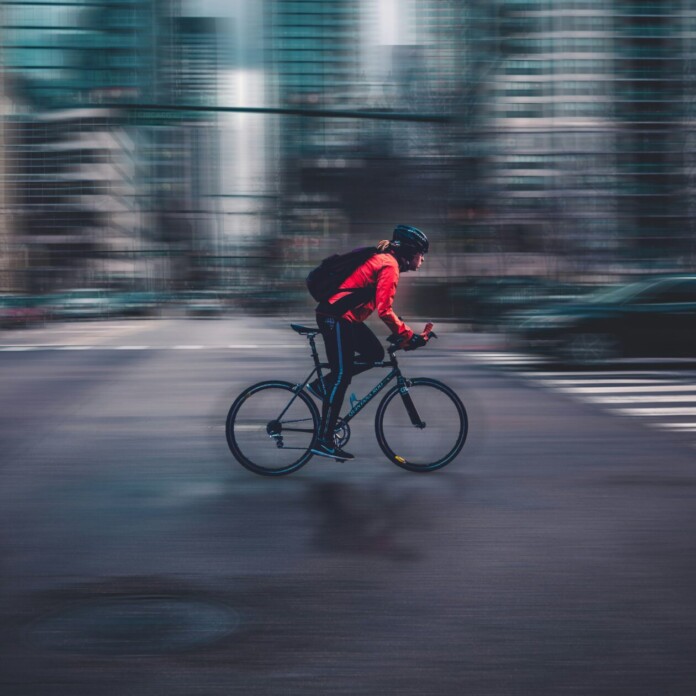
Panning is one of the most popular ways to photograph movement because it strikes a balance between clarity and speed. The idea is simple: you track your subject with the camera while using a relatively slow shutter speed. If done well, the subject stays sharp while the background turns into streaks that emphasize direction and velocity.
For example:
- A race car with crisp details, surrounded by rushing colors.
- A cyclist frozen in motion with the road streaking beneath them.
How to pan effectively:
- Switch to shutter-priority mode on your camera.
- Choose a shutter speed like 1/30 or 1/60 of a second (experiment depending on subject speed).
- Follow the subject smoothly with your camera, pressing the shutter while continuing to track.
- Use continuous autofocus so the subject stays sharp as it moves.
The key to panning is practice. You’ll need to take many shots before you achieve the perfect balance between sharp subject and blurred background.
4. Multiple exposures (chrono photography)
Sometimes, instead of capturing a single moment, you may want to show several moments layered together. This is called multiple exposure photography. By combining a sequence of images, you can illustrate the entire path of motion in one frame.
For instance:
- A skateboarder flipping through the air, each stage of the trick visible.
- A gymnast’s leap broken into several phases.
- A tennis serve with the racket appearing in multiple positions.
This technique was pioneered in the late 1800s by scientists like Étienne-Jules Marey, who used sequential photos to study motion. Today, you can recreate it either by using in-camera multiple exposure features (available on some cameras) or by merging separate shots in post-processing software.
5. Using flash or strobes to stop action
Another way to freeze movement — especially in low-light situations — is to use flash. A short burst of flash, lasting only a fraction of a millisecond, can stop motion far more effectively than a fast shutter alone.
This technique is often used in:
- Water droplet photography (capturing the splash as it hits a surface).
- Balloon-popping or high-speed science experiments.
- Dance photography, where strobes freeze a subject mid-leap.
Specialized high-speed flashes or studio strobes can give you dramatic results. Sometimes, photographers combine a slow shutter with flash to capture both blur and sharpness in one image.
6. Long exposure for flow and time
Long-exposure photography emphasizes how time transforms a scene. By leaving the shutter open for several seconds — or even minutes — you can blur anything that moves while keeping still objects sharp.
Classic examples include:
- Waterfalls turned silky and smooth.
- Clouds stretched across the sky.
- Car headlights creating glowing trails along a highway.
This method works best with a tripod, since any shake from your hands would blur the whole picture. Neutral density filters (ND filters) are often used in daylight to reduce brightness, allowing you to use longer exposures without overexposing the shot.
7. Choosing the Right Shutter Speed
Shutter speed is the single most important factor in motion photography. There’s no universal “correct” speed— it always depends on:
- How fast the subject is moving.
- How close you are to the action.
- Whether you want sharpness, blur, or a mix of both.
A flying bird might require 1/2000 of a second to freeze clearly, while a slow-moving river may need several seconds to show smooth flow. The only way to learn is to experiment with different speeds and review the results.
8. Avoiding overexposure at slow speeds
When you use slow shutter speeds, your camera gathers more light, which can easily result in overexposed photos. To prevent this, you can:
- Narrow the aperture (choose a higher f-stop number like f/16 or f/22).
- Lower the ISO (reduce sensitivity so the sensor collects less light).
- Use ND filters (darkened glass that reduces the amount of light entering the lens).
Balancing shutter, aperture, and ISO is the essence of exposure control — and mastering this “triangle” is what separates snapshots from intentional photography.
9. Burst mode (continuous shooting)
Sometimes, movement happens too quickly to capture in a single attempt. This is where burst mode comes in. By holding down the shutter button, your camera rapidly takes multiple frames per second.
This increases your chances of catching the perfect moment — like a soccer player kicking a ball, or a child jumping into a pool. Later, you can select the sharpest or most expressive frame from the series.
Professional sports photographers rely heavily on burst mode, combined with telephoto lenses and fast memory cards, to ensure they don’t miss critical moments.
Final thoughts
Photographing motion is one of the most rewarding skills a photographer can learn. It allows you to break free from static snapshots and instead create images that move the viewer emotionally.
Whether you freeze action with high shutter speeds, blur it for a sense of flow, or experiment with panning, multiple exposures, or flash, the key is practice. Try each method in different environments — city streets, sporting events, natural landscapes, or even your own living room.
Remember:
- Technical control gives you the tools.
- Creativity gives you the vision.
By blending the two, you can master the art of motion and bring your photographs to life.
 in Bahia.